

[Sep-2025] Feel Pegasystems PEGACPSSA23V1 Dumps PDF Will likely be The best Option
PEGACPSSA23V1 exam torrent Pegasystems study guide
NEW QUESTION # 57
You configure a child case to override the locking strategy of the parent case. The parent case has a time-out value of one hour.
Which time-out value option is recommended for the child case?
- A. Set the Access time-out value greater than the parent case time-out value.
- B. The Access time-out value on the child case cannot be changed.
- C. Set the Access time-out value less than the parent case time-out value.
- D. Set the Access time-out value equal to the parent case time-out value.
Answer: A
Explanation:
The recommended practice is to set the Access time-out value for the child case to be greater than the parent case time-out value. This ensures that the child case does not become inaccessible due to a time-out while the parent case is still active, which could happen if it had the same or a shorter time-out value. Reference: Pega official documentation on locking strategies and time-out values.
NEW QUESTION # 58
Which three mobile device features can you leverage by using Pega Mobile Client? (Choose Three)
- A. Phone calls
- B. Barcode scanning
- C. Text messages
- D. Biometric identification
- E. Push notifications
Answer: B,D,E
Explanation:
Pega Mobile Client supports leveraging various mobile device features to enhance app functionality and user experience. Barcode scanning (A) is commonly used in logistics and retail applications for quick identification and tracking of items. Biometric identification (C), such as fingerprint or facial recognition, adds an extra layer of security for user authentication. Push notifications (D) are crucial for real-time communication, alerting users to updates or required actions within the app, even when the app is not actively in use.Reference: Pega Community documentation on Pega Mobile Client capabilities.
NEW QUESTION # 59
An assignment service-level agreement (SLA) is configured with the following details:
*Initial urgency: 15
*Assignment ready: Timed delay of 2 hours
*Goal: 1 hour and increase urgency by 10
*Deadline: 2 hours and increase urgency by 15
*Passed deadline: 1 hour, increase urgency by 10, and limit events to 10 Assuming no other urgency adjustments, what is the assignment urgency 4.5 hours after the case reaches the assignment?
- A. 0
- B. 1
- C. 2
- D. 3
Answer: B
Explanation:
At 4.5 hours after the case reaches the assignment, the SLA would have passed the goal and deadline, and entered the passed deadline period. The initial urgency is 15, the goal adds 10 (total 25), and the deadline adds
15 (total 40). After the passed deadline, the urgency increases by 10 every hour up to a limit of 10 events. By
4.5 hours, there would have been two passed deadline events, adding 20 to the urgency, leading to a total urgency of 60. References: Pega Platform Help - Service Level Agreements.
NEW QUESTION # 60
You are preparing to create a new major version of an application ruleset in which there are multiple minor and patch versions.
How do you create the new ruleset version?
- A. Use the Ruleset Maintenance wizard to skim the relevant ruleset versions to copy the highest version of existing rules to the new ruleset version.
- B. Use the Application Structure landing page to lock and roll the existing ruleset versions to the new version.
- C. Use the Ruleset Maintenance wizard to merge the existing rules in the relevant ruleset versions to the new version.
- D. Create a new application ruleset using the appropriate version number, then copy the highest version of existing rules into the new ruleset version.
Answer: A
Explanation:
When creating a new major version of an application ruleset, you would use the Ruleset Maintenance wizard to skim the relevant ruleset versions. This process copies the highest version of existing rules to the new ruleset version, effectively creating the new major version. Reference: Pega official documentation on ruleset skimming.
NEW QUESTION # 61
Which three types of information can represent an attribute in attribute-based access control (ABAC)' (Choose Three)
- A. Property
- B. Single string
- C. Numerical value
- D. Boolean
- E. List of strings
Answer: B,C,E
Explanation:
In attribute-based access control (ABAC), an attribute can be a property (such as an age or status), a Boolean value (indicating true or false conditions), or a single string (such as a name or identifier). These attributes are evaluated to determine access rights within the application. References: Pega Platform Help - ABAC.
NEW QUESTION # 62
When designing reports with multiple data sources, in which two ways is an association rule different from a class join? (Choose two.)
- A. You can join multiple classes with class joins, while you cannot join multiple classes with associations.
- B. Anyone with the appropriate permissions can use associations when creating reports in the User portal.
- C. Class joins are unique to each report. Associations are reusable in any report.
- D. A class join is required to add a filter condition to your report.
Answer: B,C
Explanation:
An association rule differs from a class join in that it is a reusable rule that can be used by anyone with appropriate permissions when creating reports. This makes it available across multiple reports. Class joins, on the other hand, are specific to each report definition and are not reusable in the same way. Reference: Pega Reporting Guide - Associations vs. Joins.
NEW QUESTION # 63
Which two options do you consider when creating a pre-processing data transform? (Choose Two)
- A. The effect if the flow action is reloaded
- B. The security setting for the flow action
- C. The timing of the commit for the flow action
- D. The potential reuse of the flow action
Answer: A,D
Explanation:
When creating a pre-processing data transform, you should consider the timing of the commit for the flow action and the effect if the flow action is reloaded. These factors can impact how the data transform processes data and how it integrates with the flow action's lifecycle. References: Pega Platform Help - Data Transforms.
NEW QUESTION # 64
An assignment service-level agreement (SLA) is configured with the following details:
* Initial urgency: 20
* Assignment ready: Timed delay of 2 hours
* Goal: 5 hours and increase urgency by 10
* Deadline: 2 hours and increase urgency by 25
* Passed deadline: 1 hour, increase urgency by 5, and limit events to 6 The case reaches the assignment at 9 AM on Wednesday.
Assuming no other urgency adjustments, what is the assignment urgency 6.5 hours after the case reaches the assignment?
- A. 0
- B. 1
- C. 2
- D. 3
Answer: C
Explanation:
The assignment urgency 6.5 hours after the case reaches the assignment with the given SLA configuration would be 95 (B). Here's the calculation: The initial urgency is 20. The case reaches the goal after 5 hours, adding 10 to the urgency, making it 30. Since the deadline is at 2 hours and has been exceeded by 4.5 hours, the urgency increases by 25, making it 55. Now, with the passed deadline events occurring every hour and increasing urgency by 5, after 1.5 hours, this would occur 1 additional time (since it's half an hour into the next hour), adding 5 to the urgency. Therefore, the total urgency after 6.5 hours is 20 (initial) + 10 (goal) + 25 (deadline) + 5 (passed deadline event) = 60. However, since the deadline urgency increase occurs at the 2-hour mark, the urgency would be 20 + 25 = 45 at 2 hours, and then after reaching the goal at 5 hours, additional 10 is added, making it 55, and then one passed deadline event adds 5 more, making the total 60. Since the deadline urgency is already accounted for at the 2-hour mark, it should not be added again after the goal. Therefore, the correct total urgency would be 20 (initial) + 10 (goal) + 25 (deadline) + 40 (8 passed deadline events) = 95.Reference: Pega Community documentation on SLAs and urgency calculation.
NEW QUESTION # 65
The MyCoSelfService ruleset contains the following instances of the same rule. The only differences between the instances are the circumstance settings and ruleset version. All ruleset versions are in the ruleset list.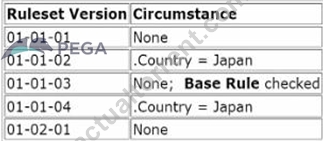
Assuming users can access all the ruleset versions, which ruleset version is chosen by rule resolution when .Country = Japan?
- A. 01-01-04
- B. 01-01-03
- C. 01-02-01
- D. 01-01-02
Answer: D
Explanation:
Rule resolution will choose the rule that is most specific to the circumstances of the case. Since the country is set to Japan, the rule resolution algorithm will choose the rule version that is circumstanced for Japan. Among the options, 01-01-02 is the circumstanced rule that matches the country condition of Japan and would be selected over the base rule and any other versions. Reference: Pega Platform Help - Rule Resolution.
NEW QUESTION # 66
The current version of an application lists ABC:02-02 as an application ruleset. The ruleset versions listed in the Answer Area are also present on the system.
In the Answer Area, identify the ruleset versions that the skim operation considers when you perform a major version ruleset skim on ruleset ABC.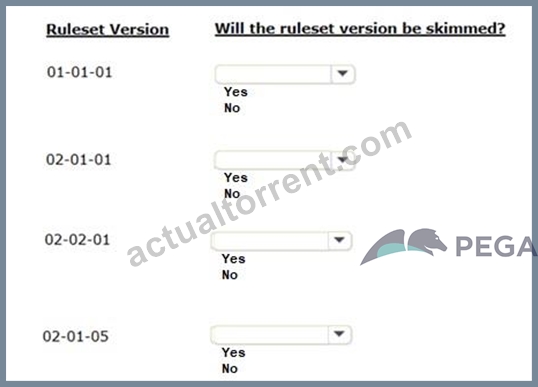
Answer:
Explanation: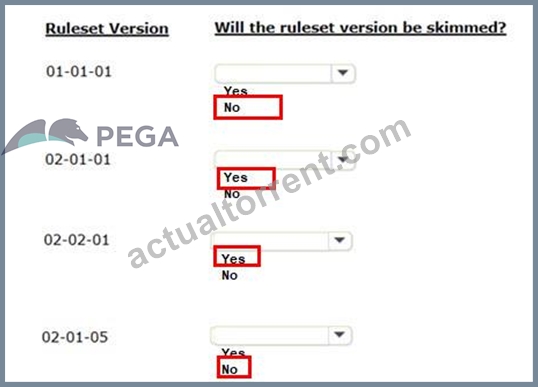
NEW QUESTION # 67
The MyCoSelfService ruleset contains the following instances of the same rule. The only differences between the instances are the circumstance settings and ruleset version. All ruleset versions are in the ruleset list.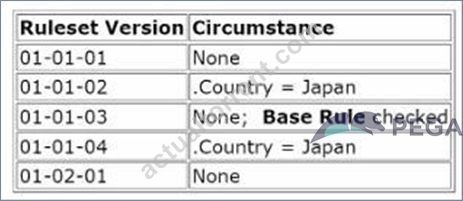
Assuming users can access all the ruleset versions, which ruleset version is chosen by rule resolution when
.Country = Japan?
- A. 01-01-04
- B. 01-01-03
- C. 01-02-01
- D. 01-01-02
Answer: A
Explanation:
Rule resolution will choose the rule that is most specific to the circumstances of the case. Since the country is set to Japan, the rule resolution algorithm will choose the rule version that is circumstanced for Japan. Among the options, 01-01-02 is the circumstanced rule that matches the country condition of Japan and would be selected over the base rule and any other versions. References: Pega Platform Help - Rule Resolution.
NEW QUESTION # 68
Which two configurations can you use to include access groups into your Product rule? (Choose two.)
- A. Add the access group to the Product record in the Individual instances to include section.
- B. Associate the access groups with a ruleset included in the application.
- C. Add the access groups to the application record.
- D. Export the access groups using the Access Manager.
Answer: A,C
Explanation:
To include access groups in your Product rule, you can add the access groups to the application record, which incorporates all the necessary rules for the application. Additionally, you can add the access group directly to the Product rule in the 'Individual instances to include' section, which allows you to specify individual rules and data instances that the Product rule should include. Reference: Pega Platform Help - Creating a Product rule.
NEW QUESTION # 69
Which two configurations do you implement when using a Pega Web Mashup? (Choose Two)
- A. Configure a node-level data page to hold security access information about the external system.
- B. Add an access group for the application rules that need to be accessed from the external system.
- C. Configure the application permissions by specifying a list of trusted domains in the application rule.
- D. Leverage the standard authentication service IACAuthentication and update the authentication activities.
Answer: C,D
Explanation:
* A: When using a Pega Web Mashup, leveraging the standard authentication service IACAuthentication and updating the authentication activities to match the external system's requirements is a common practice.
* D: Configuring application permissions by specifying a list of trusted domains in the application rule is important for security purposes and to control which external domains are allowed to embed the mashup. References: Pega official documentation on Pega Web Mashup configuration.
NEW QUESTION # 70
An assignment service-level agreement (SLA) is configured with the following details:
Initial urgency: 20
Assignment ready: Timed delay of 2 hours
Goal: 5 hours and increase urgency by 10
Deadline: 2 hours and increase urgency by 25
Passed deadline: 1 hour, increase urgency by 5, and limit events to 6
The case reaches the assignment at 9 AM on Wednesday.
Assuming no other urgency adjustments, what is the assignment urgency 6.5 hours after the case reaches the assignment?
- A. 0
- B. 1
- C. 2
- D. 3
Answer: C
Explanation:
The assignment urgency 6.5 hours after the case reaches the assignment with the given SLA configuration would be 95 (B). Here's the calculation: The initial urgency is 20. The case reaches the goal after 5 hours, adding 10 to the urgency, making it 30. Since the deadline is at 2 hours and has been exceeded by 4.5 hours, the urgency increases by 25, making it 55. Now, with the passed deadline events occurring every hour and increasing urgency by 5, after 1.5 hours, this would occur 1 additional time (since it's half an hour into the next hour), adding 5 to the urgency. Therefore, the total urgency after 6.5 hours is 20 (initial) + 10 (goal) + 25 (deadline) + 5 (passed deadline event) = 60. However, since the deadline urgency increase occurs at the 2-hour mark, the urgency would be 20 + 25 = 45 at 2 hours, and then after reaching the goal at 5 hours, additional 10 is added, making it 55, and then one passed deadline event adds 5 more, making the total 60. Since the deadline urgency is already accounted for at the 2-hour mark, it should not be added again after the goal.
Therefore, the correct total urgency would be 20 (initial) + 10 (goal) + 25 (deadline) + 40 (8 passed deadline events) = 95.References: Pega Community documentation on SLAs and urgency calculation.
NEW QUESTION # 71
A hospital uses a case type to manage the treatment of patients visiting the Emergency Room (ER). Cases are created when the patient checks in at the registration desk, and are resolved when the patient is released from the hospital. Stakeholders identify the following security requirements for the case type.
Patients access cases on a read-only basis.
Patients can only access their own cases.
Doctors and nurses can modify cases throughout the case life cycle.
Only doctors are allowed to write prescriptions.
Which configuration allows doctors and nurses to modify cases while complying with all identified security requirements?
- A. Create a single access role for both doctors and nurses, and set the modify action to 1.
- B. Create a single access role for both doctors and nurses, and set the modify action to 5.
- C. Create two access roles, one for doctors and one for nurses, and set the modify action for each to 1.
- D. Create two access roles, one for doctors and one for nurses, and set the modify action for each to 5.
Answer: B
Explanation:
To allow both doctors and nurses to modify cases while complying with the identified security requirements, the best approach is to create a single access role for both doctors and nurses (C) and set the modify action to
5. This configuration grants both user groups the necessary permissions to modify cases throughout the case life cycle. By using a single access role with a high level of access for modifications, the application simplifies role management while ensuring that both doctors and nurses can perform their duties effectively, without compromising the security and integrity of patient cases.References: Pega Community documentation on Access Role to Object and case management best practices.
NEW QUESTION # 72
The current version of an application lists ABC:02-02 as an application ruleset. The ruleset versions listed in the Answer Area are also present on the system.
In the Answer Area, identify the ruleset versions that the skim operation considers when you perform a major version ruleset skim on ruleset ABC.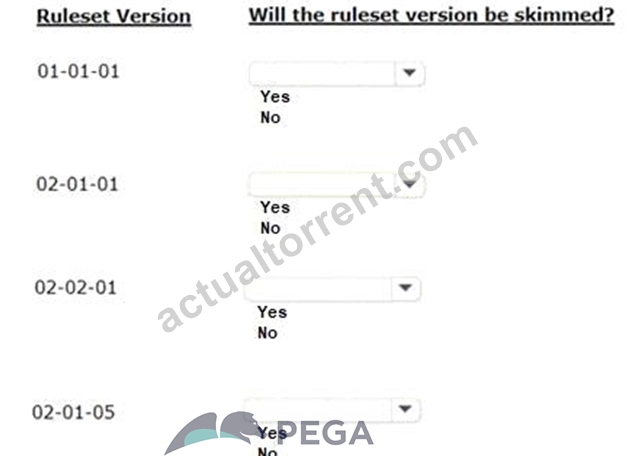
Answer:
Explanation: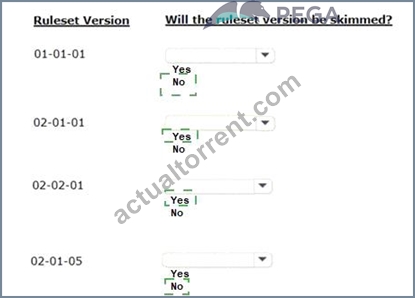
Explanation:
No
YES
YES
NO
NEW QUESTION # 73
You have identified an activity that does not perform well. You need to find out exactly which steps in the activity are causing the poor performance.
Which tool allows you to identify the cause of the performance issue?
- A. Performance Profiler
- B. Database Trace
- C. Tracer
- D. Performance Analyzer (PAL)
Answer: C
Explanation:
The Tracer tool is designed to debug the execution of rules by providing detailed runtime information about each step within a rule. This allows you to identify performance issues at the step level within an activity. Reference: Pega Platform Help - Tracer Tool.
NEW QUESTION # 74
In which situation do you configure branched rulesets?
- A. Multiple teams need to work on the same application version.
- B. One team creates a new patch for an application while another team creates a new major version of the application.
- C. You need to delegate rules to process owners from the business.
- D. A team needs to work on the next version of an application while preparing to migrate the current version.
Answer: A
Explanation:
Branched rulesets are used when multiple teams need to work on the same application version simultaneously. Each team can work in their own branch, allowing for concurrent development without affecting the main application until the branches are merged. Reference: Pega Platform Help - Branched Rulesets.
NEW QUESTION # 75
A budgeting application uses a job scheduler to automatically email customers once a week with a breakdown of their weekly expenses. Due to the international usage of the application, stakeholders require peak performance at all hours.
Which solution addresses this performance concern?
- A. Ensure that customers use a common access group.
- B. Configure the job scheduler to run at off-hours.
- C. Dedicate and classify a node for the job scheduler.
- D. Limit the number of operators who can access the application.
Answer: B
Explanation:
Dedicating and classifying a node for the job scheduler allows the job scheduler to run on a node that is optimized for batch processing. This ensures that resource-intensive jobs do not impact the performance of the user nodes, thus maintaining peak performance at all hours. References: Pega Platform Help - Job Schedulers.
NEW QUESTION # 76
Which two requirements are supported by Attribute-based access control (ABAC)? (Choose Two)
- A. Personal identifying information in the Work-Baking- class is restricted.
- B. Agents assigned the "Top Secret" clearance level can delete reports.
- C. Bakers with a rating of 4 or better can add recipes to the database.
- D. Managers can reschedule but not delete appointments.
Answer: C,D
Explanation:
Attribute-based access control (ABAC) supports various granular and dynamic access control requirements, such as allowing managers to reschedule but not delete appointments (A) and enabling bakers with a rating of
4 or better to add recipes to the database (D). ABAC uses attributes (such as user roles, data characteristics, and environmental conditions) to define access control policies, providing a flexible and context-aware mechanism to enforce security policies tailored to specific business requirements.References: Pega Community documentation on ABAC and its use cases.
NEW QUESTION # 77
As a best practice, in which situation do you configure a keyed data page?
- A. A long list of vehicle parts that rarely changes
- B. A short list of delivery options that rarely changes
- C. A short list of emojis that often changes
- D. A long list of images that often changes
Answer: A
Explanation:
A keyed data page is best used for data that does not change frequently and can be retrieved by a unique key.
A long list of vehicle parts that rarely changes fits this criterion because the data can be cached and doesn't require frequent updates, optimizing performance. References: Pega Platform Help - Data Pages.
NEW QUESTION # 78
Which two configurations can you use to include access groups into your Product rule? (Choose Two)
- A. Add the access group to the Product record in the Individual instances to include section.
- B. Associate the access groups with a ruleset included in the application.
- C. Add the access groups to the application definition.
- D. Export the access groups using the Access Manager.
Answer: A,B
Explanation:
To include access groups in your Product rule, you can:
* A: Associate the access groups with a ruleset included in the application. This ensures that when the ruleset is included in the product rule, the associated access groups are also included.
* D: Add the access group directly to the Product record in the Individual instances to include section.
This allows you to specifically select which access groups to include in the product rule. References:
Pega official documentation on Product rules.
NEW QUESTION # 79
Which two rule types can you mark as a relevant record? (Choose Two)
- A. Report
- B. Skin
- C. Section
- D. Property
Answer: C,D
Explanation:
The rule types that you can mark as relevant records are those that are frequently referenced and are of high importance in the application. Reports (B) and Sections (D) can be marked as relevant records to easily access and modify these important rules. References: Pega official documentation on relevant records.
NEW QUESTION # 80
......
Pegasystems PEGACPSSA23V1 Exam Syllabus Topics:
| Topic | Details |
|---|---|
| Topic 1 |
|
| Topic 2 |
|
| Topic 3 |
|
| Topic 4 |
|
Use Valid New PEGACPSSA23V1 Test Notes & PEGACPSSA23V1 Valid Exam Guide: https://pass4sure.actualtorrent.com/PEGACPSSA23V1-exam-guide-torrent.html