

Latest 400-007 Exam Real Tests Free Updated Today
400-007 Real Exam Question Answers Updated [Jun 21, 2026]
Cisco 400-007 exam consists of multiple-choice and scenario-based questions. 400-007 exam duration is 120 minutes, and candidates must score at least 80% to pass. 400-007 exam is available in English and Japanese languages. A CCDE certification is valid for three years, after which candidates must recertify by passing the CCDE practical exam or by earning credits through continuing education activities. Overall, the Cisco 400-007 exam is a rigorous and comprehensive test that validates the candidate’s expertise in network design and architecture.
NEW QUESTION # 265
What advantage of placing the IS-IS layer 2 flooding domain boundary at the core Layer in a three-layer hierarchical network is true?
- A. The Layer 2 domain is contained and more stable
- B. It reduces the complexity of the Layer 1 domains
- C. The Layer 1 and Layer 2 domains can easily overlap
- D. It can be applied to any kind of topology
Answer: A
NEW QUESTION # 266
Sometimes SDN leverages various overlay networking technologies to create layer(s) of network abstraction.
What describes an overlay network?
- A. It is responsible for the delivery of packets; NAT- or VRF-based segregation is required
- B. It encapsulates packets at source and destination, which incurs additional overhead
- C. It transmits packets that traverse over network devices like switches and routers
- D. Packet delivery and reliability occurs at Layer 3 and Layer 4
Answer: B
Explanation:
* B (Encapsulation at source and destination):Overlay networks encapsulate payloads inside another protocol (e.g. VXLAN, GRE, MPLS), adding headers that enable separation from the underlay network while introducing minor overhead due to encapsulation.
Other options explained:
* A: Describes underlay behavior.
* C: Overlay encapsulation occurs independently of L3/L4 reliability.
* D: NAT or VRF are isolation mechanisms but not how overlays function.
NEW QUESTION # 267
The Layer 3 control plane is the intelligence over the network that steers traffic toward its intended destination. Which two techniques can be used in service provider-style networks to offer a more dynamic, flexible, controlled, and secure control plane design? (Choose two.)
- A. QoS policy propagation with BGP
- B. firewalls
- C. prefix lists
- D. remote black-holing trigger
- E. access control lists
Answer: C,D
NEW QUESTION # 268
Refer to the exhibit.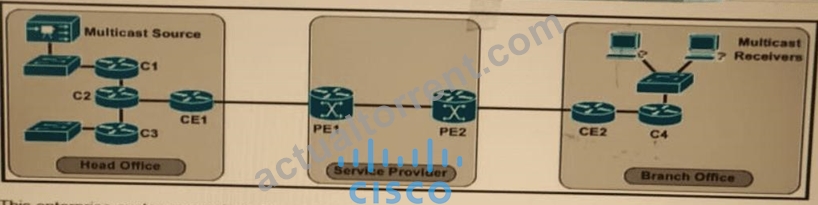
The enterprise customer wants to stream one-way video from their head office to eight branch offices using multicast. Their current service provider provides a Layer 3 VPN solution and manages the CE routers, but they do not currently support multicast. Which solution quickly allows this multicast traffic to go through while allowing for future scalability?
- A. Implement hub and spoke MPLS VPN over DMVPN (also known as 2547o DMVPN) between CE1 and CE2
- B. Enable a GRE tunnel between nodes C1 and C4
- C. Enable a GRE tunnel between nodes C2 and C4
- D. Enable a GRE tunnel between nodes CE1 and CE2
- E. The service provider must provide a Draft Rosen solution to enable a GRE tunnel between nodes PE1 and PE2
Answer: C
Explanation:
When a service provider does not support multicast over their Layer 3 VPN, the enterprise can useGRE tunnels between Customer Edge (CE) devicesto transport multicast traffic. This method allows the customer to encapsulate multicast packets in unicast GRE packets, which are routable through the provider's non-multicast core.
In this scenario, the most scalable and immediate solution is to establish a GRE tunnel betweenC2 (in the head office CE router path)andC4 (at the branch office). This setup ensures that multicast traffic originating at the head office is tunneled directly to the multicast receivers, bypassing the service provider's non-multicast-aware core.
This strategy is directly aligned with CCDE v3.1 principles, which emphasize:
* Minimizing service provider dependency
* Providing a scalable, customer-controlled overlay solution
* Ensuring protocol compatibility across domains
Why other options are incorrect:
* A: Tunnel between CE1 and CE2 is less optimal, as it may not originate or terminate at the exact multicast endpoints.
* C: Tunnel between C1 and C4 is less aligned with CE-to-CE design expectations and may bypass required edge security/policy controls.
* D: 2547oDMVPN is more complex and intended for full-scale VPN overlays, not quick multicast solutions.
* E: Draft Rosen requires service provider support, which is currently unavailable, hence not a valid short- term option.
This solution ensures operational simplicity and future scalability with minimal provider dependency, which are core principles outlined in the CCDE v3.1 design methodology.
NEW QUESTION # 269
A customer migrates from a traditional Layer 2 data center network into a new SDN-based. spine-and-leaf VXLAN EVPN data center within the same location. The networks are joined to enable host migration at Layer 2 Which activity should be completed each time a legacy network is migrated?
- A. The migrated network should be added to the EVPN BGP routing.
- B. The migrated network should have a VXLAN VNID configured within the new network.
- C. The migrated VLAN should be pruned from the Layer 2 interconnects.
- D. The migrated network should be advertised to the EVPN network as a Type 2 network.
Answer: C
NEW QUESTION # 270
Refer to the exhibit.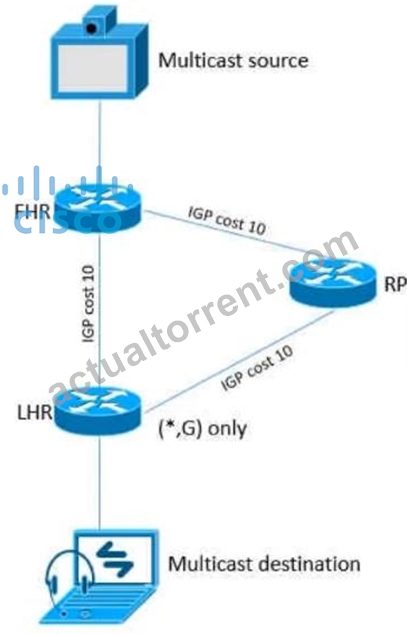
As part of a redesign project, you must predict multicast behavior What happens to the multicast traffic received on the shared tree (*,G), if it is received on the LHR interface indicated*?
- A. It is switched give that no RPF check is performed
- B. It is switched due to a successful RPF check against the routing table
- C. It is dropped due to an unsuccessful RPF check against the multicast source
- D. It is dropped due to an unsuccessful RPk8t8ck against the multicast receiver.
Answer: C
Explanation:
https://www.cisco.com/c/en/us/support/docs/ip/ip-multicast/16450-mcastguide0.html When a multicast packet arrives on an interface, the RPF process checks to ensure that this incoming interface is the outgoing interface used by unicast routing in order to reach the source of the multicast packet. This RPF check process prevents loops. Multicast routing does not forward a packet unless the source of the packet passes a RPF check. Once a packet passes this RPF check, multicast routing forwards the packet based only upon the destination address.
NEW QUESTION # 271
Which technology supports antispoofing and does not have any impact on encryption performance regardless of packet size?
- A. IP source guard
- B. DHCP snooping with DAI
- C. IPsec
- D. MACsec
Answer: A
Explanation:
* B (IP Source Guard):IP Source Guard prevents IP address spoofing at Layer 2 by binding IP-to-MAC addresses and filtering unauthorized source IPs. It operates independently of encryption, so it has no impact on encryption performance.
Other options explained:
* A: MACsec adds encryption and has performance implications.
* C: DHCP snooping with DAI focuses on ARP spoofing, not IP address antispoofing specifically.
* D: IPsec handles encryption, which directly impacts performance.
NEW QUESTION # 272
Which two data plane hardening techniques are true? (Choose two)
- A. routing protocol authentication
- B. disable unused services
- C. infrastructure ACLs
- D. redundant AAA servers
- E. SNMPv3
- F. Control Plane Policing
- G. warning banners
Answer: B,C
NEW QUESTION # 273
The network team in XYZ Corp wants to modernize their infrastructure and is evaluating an implementation and migration plan to allow integration MPLS-based, Layer 2 Ethernet services managed by a service provider to connect branches and remote offices. To decrease OpEx and improve response times when network components fail, XYZ Corp decided to acquire and deploy new routers. The network currently is operated over E1 leased lines (2 Mbps) with a managed CE service provided by the telco.
Drag and drop the implementation steps from the left onto the corresponding targets on the right in the correct order.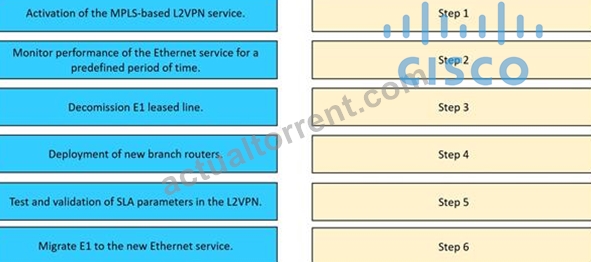
Answer:
Explanation: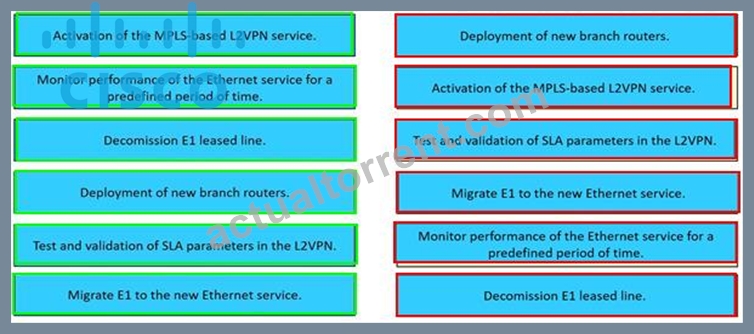
NEW QUESTION # 274
Which two statements describe the hierarchical LAN design model? (Choose two)
- A. It is a well-understood architecture that provides scalability
- B. It provides a simplified design
- C. It is the most optimal design but is highly complex
- D. Changes, upgrades, and new services can be introduced in a controlled and staged manner
- E. It is the best design for modern data centers
Answer: A,D
Explanation:
The hierarchical LAN design model - access, distribution, core - provides:
* Scalability through structured hierarchy (A).
* Easier change management and staged deployments since functions are isolated at each layer (E).
CCDE v3.1 emphasizes hierarchy for long-term scalability, manageability, and operational stability.
Why other options are incorrect:
* B: Modern data centers favor spine-leaf over traditional hierarchy.
* C: The model simplifies rather than complicates.
* D: Simplification is not its primary advantage - scalability and modularity are.
-
NEW QUESTION # 275
A network security team uses a purpose-built tool to actively monitor the campus network, applications, and user activity. The team also analyzes enterprise telemetry data from IPFIX data records that are received from devices in the campus network. Which action can be taken based on the augmented data?
- A. integration with an incident response plan
- B. asset identification and grouping decisions
- C. reduction in time to detect and respond to threats
- D. adoption and improvement of threat-detection response
Answer: A
NEW QUESTION # 276
Refer to the exhibit.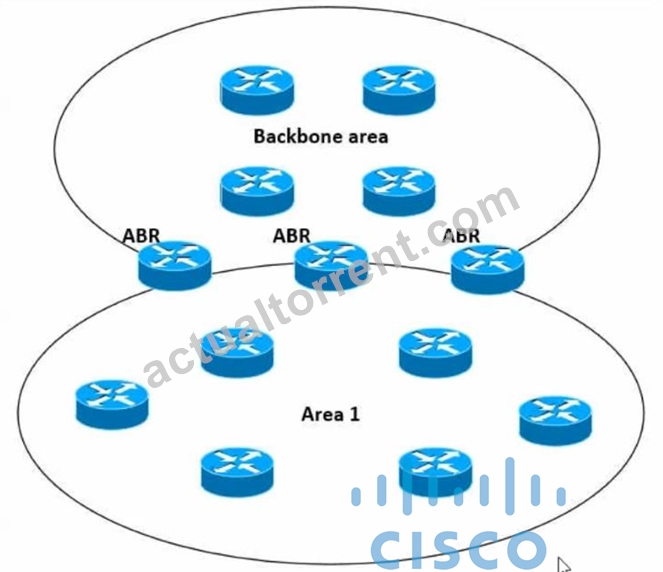
Which impact of using three or more ABRs between the backbone area and area 1 is true?
- A. In a large-scale network multiple ABRs can create microloops.
- B. Multiple ABRs reduce the CPU processing on each A6R due to splitting prefix advertisement
- C. In a large-scale network LSA replication by all ABRs can cause serious scalability issues
- D. Prefixes from the non-backbone area are advertised by one ABR to the backbone
Answer: C
NEW QUESTION # 277
During a pre-sales meeting with a potential customer, the customer CTO asks a question about advantages of controller-based networks versus a traditional network. What are two advantages to mention? (Choose two.)
- A. abstraction of individual network devices
- B. programmatic APIs available per device
- C. per device forwarding tables
- D. distributed control plane
- E. consistent device configuration
Answer: A,E
Explanation:
Abstraction of individual network devices: In a controller-based network, the network controller abstracts the individual devices, simplifying management and enabling centralized control and visibility. This leads to easier configuration and troubleshooting.
Consistent device configuration: A controller-based network ensures that configurations are consistent across the network, as policies and configurations can be applied centrally through the controller, reducing the risk of misconfigurations.
NEW QUESTION # 278
Which option is a fate-sharing characteristic in regards to network design?
- A. A failure of a single element causes the entire service to fail
- B. It provides data sequencing and acknowledgment mechanisms
- C. It protects the network against failures in the distribution layer
- D. It acts as a stateful forwarding device
Answer: A
Explanation:
Fate-sharing describes a situation where two or more services or components are tied together such that failure in one leads to failure in others. In resilient design, the goal is often to eliminate fate-sharing by decoupling dependencies.
* A: A single point of failure (like a shared power supply or converged service path) that brings down multiple components exemplifies fate-sharing.
* B is incorrect because fate-sharing is a risk, not a protective measure.
* C and D refer to device behavior (stateful inspection, transport layer behavior) rather than architectural dependency.
NEW QUESTION # 279
An engineer must design a network for a company that uses OSPF LFA to reduce loops. Which type of loop would be reduced by using this design?
- A. Micro loops
- B. REP
- C. STP
- D. DTP
Answer: A
Explanation:
* B (Micro loops):OSPF Loop-Free Alternates (LFA) pre-calculate backup next-hops to reduce transient micro loops during the convergence process when primary routes fail.
Other options explained:
* A: DTP relates to trunk negotiation, not loop prevention.
* C: STP handles Layer 2 loops.
* D: REP is a Cisco Layer 2 redundancy protocol, unrelated to OSPF loop prevention.
NEW QUESTION # 280
Drag and Drop Question
Drag and drop the FCAPS network management reference models from the left onto the correct definitions on the right.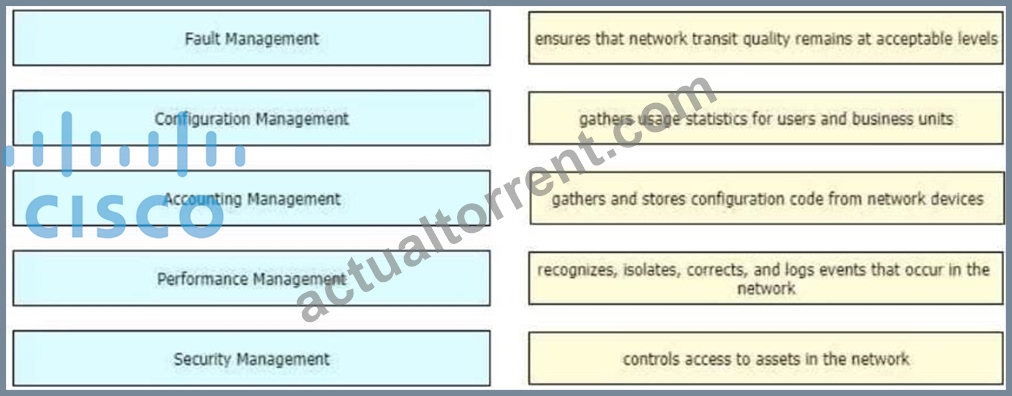
Answer:
Explanation: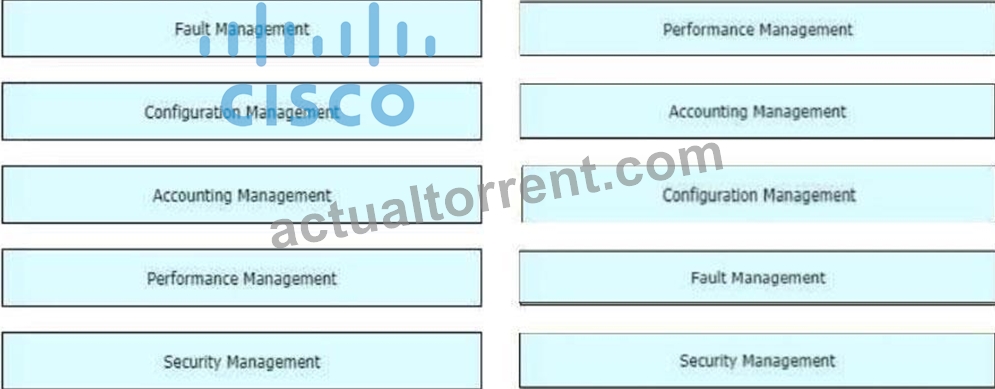
NEW QUESTION # 281
A banking customer determines that it is operating POS and POI terminals that are noncompliant with PCI DSS requirements, as it is running TLSv1.0. The customer plans to migrate the terminals to TLSv1.2. What are two requirements to complete the migration? (Choose two.)
- A. Apply strong encryption for transmission of cardholder data across public networks.
- B. Protect all user systems against malware and frequently update antivirus software
- C. Ensure that strong cryptography is applied for users who have administrative access through networks
- D. Apply strong cryptography and security protocols to safeguard sensitive cardholder data.
- E. Maintain a policy that addresses information security for employees and third parties.
Answer: A,D
Explanation:
* B (Strong cryptography for cardholder data):PCI DSS requires strong cryptographic protocols (e.g.
TLS 1.2 or higher) to protect sensitive data during processing and storage.
* C (Strong encryption for transmission):Data-in-transit across public or untrusted networks must be encrypted using strong protocols to comply with PCI DSS.
Other options explained:
* A/D/E: These are general security best practices but not directly tied to TLS upgrade compliance for cardholder data under PCI DSS.
NEW QUESTION # 282
Company XYZ has 30 sites running a legacy private WAN architecture that connects to the Internet via multiple high-speed connections. The company is now redesigning their network and must comply with these design requirements:
* Use a private WAN strategy that allows the sites to connect to each other directly and caters for future expansion.
* Use the Internet as the underlay for the private WAN.
* Securely transfer the corporate data over the private WAN.
Which two technologies should be incorporated into the design of this network? (Choose two.)
- A. PPTP
- B. DMVPN
- C. IPsec
- D. GET VPN
- E. S-VTI
Answer: B,C
Explanation:
* B (IPsec): Provides encryption over the public Internet for secure data transfer.
* C (DMVPN): Creates a dynamic, scalable private WAN overlay across the Internet allowing direct site- to-site connectivity.
Why other options are incorrect:
* A: S-VTI requires more static configuration and lacks DMVPN's scalability.
* D: GET VPN is best for MPLS/private WAN, not Internet underlays.
* E: PPTP is outdated and insecure.
-
NEW QUESTION # 283
Over the years, many solutions have been developed to limit control plane state which reduces the scope or the speed of control plane information propagation. Which solution removes more specific information about a particular destination as topological distance is covered in the network?
- A. Layering
- B. Aggregation
- C. Back-off timers
- D. Summarization
Answer: D
Explanation:
Comprehensive and Detailed Explanation From Exact Extract of Design Expert (CCDE) Summarization reduces control plane state by abstracting detailed route information. As packets move further away from the destination subnet, the network advertises summarized prefixes instead of individual host or subnet routes, minimizing control plane overhead and routing table size. This helps scale large networks and improves convergence times.
While aggregation and summarization are related, summarization specifically refers to the propagation of route prefixes and their abstraction - making it the precise fit for this question.
NEW QUESTION # 284
Which two possible drawbacks should you consider when introducing Network Functions Virtualization in a network design? (Choose two)
- A. OpenFlow must be supported in the network
- B. Bandwidth utilization increases
- C. An SDN orchestration layer is required to support NFV
- D. High-end routers are required to support NFV
- E. Traffic flows are suboptimal
Answer: C,D
NEW QUESTION # 285
Which Interconnectivity method offers the fastest convergence in the event of a unidirectional issue between three Layer 3 switches connected together with routed links in the same rack in a data center?
- A. Fiber Ethernet connectivity with UDLD enabled
- B. Copper Ethernet connectivity with BFD enabled
- C. Copper Ethernet connectivity with UDLD enabled
- D. Fiber Ethernet connectivity with BFD enabled
Answer: D
Explanation:
* BFD (Bidirectional Forwarding Detection) provides sub-second failure detection at the control plane level, making it the fastest convergence mechanism for Layer 3 routing protocols.
* Fiber Ethernet typically offers higher reliability and lower latency than copper.
* When combined, Fiber with BFD provides the most robust and quickest convergence for unidirectional failures in a routed data center environment.
Why other options are incorrect:
* A & B: Copper adds more physical susceptibility to errors.
* B & D: UDLD is a Layer 2 unidirectional detection mechanism, not optimized for Layer 3 convergence.
-
NEW QUESTION # 286
Refer to the exhibit.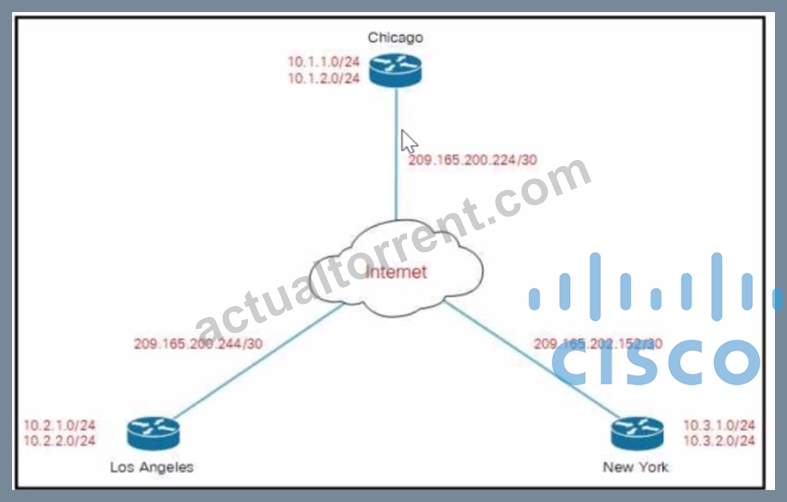
Company XYZ must design a DMVPN tunnel between the three sites Chicago is going to act as the NHS and the company wants DMVPN to detect peer endpoint failures Which technology should be used m the design?
- A. IP SLA
- B. L2TPv3
- C. GRE
- D. VPLS
Answer: A
NEW QUESTION # 287
Refer to the exhibit A service provider has a requirement to use Ethernet OAM to detect end-to- end connectivity failures between SP-SW1 and SP- SW2.
Which two ways to design this solution are true? (Choose two)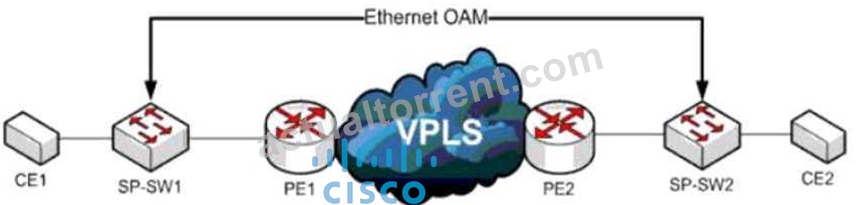
- A. Use upward maintenance endpoints on the SP switches
- B. Forward LLD PDUs over the VPLS
- C. Forward E-LMI PDUs over VPLS
- D. Enable Connectivity Fault Management on the SP switches
- E. Enable unicast heartbeat messages to be periodically exchanged between MEPs
Answer: A,D
NEW QUESTION # 288
Refer to the exhibit.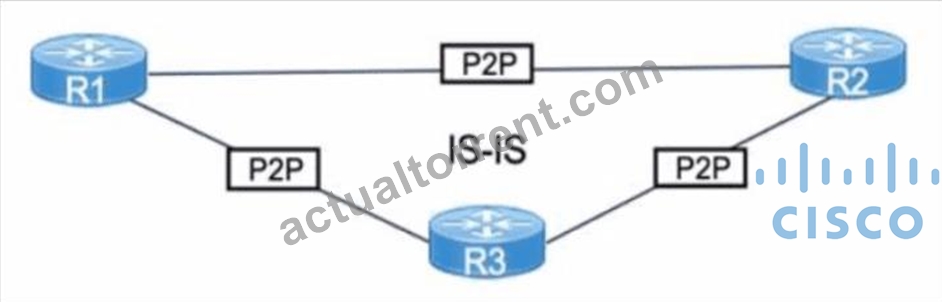
After a network audit, a network engineer must optimize the current network convergence time. The proposed solution must consider link layer and control plane failures. Which solution meets the requirements?
- A. Configure debounce timers
- B. Implement BFD
- C. Enable LSP fast flood
- D. Increase fast hello timers
Answer: B
Explanation:
To achieve subsecond convergence in IS-IS or OSPF networks and quickly detect both:
* Link-layer failures (e.g., interface flaps)
* Control-plane adjacency loss
The best solution is:
* C. BFD (Bidirectional Forwarding Detection): A lightweight protocol that enables subsecond failure detection, independent of the IGP timers, by establishing fast detection sessions over forwarding paths.
This is widely deployed in high-performance networks to accelerate convergence without compromising routing stability.
Why other options fall short:
* A. Debounce timers delay interface-down events (not suitable when fast detection is required).
* B. Fast hellos affect hello interval but are still slower and CPU-intensive.
* D. LSP fast flood improves LSP propagation but doesn't address failure detection speed.
This solution is central to CCDE "Protocol Design Implications" where rapid failure detection and recovery drive the convergence architecture.
NEW QUESTION # 289
Company XYZ has two offices connected to each other over unequal redundant paths and they are running OSPF as the routing protocol An external network architect recommends BFD for OSPF Which effect would BFD have in the case of a link failure?
- A. It would drop the dead per detection time to a single hello
- B. It would optimize the route summarization feature of OSPF
- C. It would keep an alternate path ready in case of a link failure
- D. It would detect that the neighbor is down in a subsecond manner
Answer: D
NEW QUESTION # 290
......
To be eligible to take the Cisco 400-007 exam, candidates must have a valid CCNA or CCNP certification. They must also have at least five years of experience in network design, implementation, and troubleshooting. Candidates who meet these requirements can register for the exam through the Cisco website and schedule their exam at a testing center near them.
Latest 400-007 Study Guides 2026 - With Test Engine PDF: https://pass4sure.actualtorrent.com/400-007-exam-guide-torrent.html